Generative AI tools such as ChatGPT, Claude and Microsoft Copilot are probably already in your workplace, whether or not you have approved them. People are drafting emails, summarizing meetings and analyzing spreadsheets with them. Some use them well. Others paste confidential information into public tools without a second thought. That gap is why AI training for employees has become a core business priority. Handing out licenses is not a strategy. Skills, confidence and clear guardrails turn AI from a risky experiment into a real productivity gain.
This guide covers what to teach, how training should differ for employees and business leaders, and a five-step plan to get started.
Why Giving People AI Tools Is Not Enough
Organizations that struggle with AI adoption usually buy the tools first and think about skills later. A few enthusiasts get real value, a larger group tries the tool once and gives up after a poor result, and a quiet minority avoid it because they fear getting it wrong.
Training closes that gap in three ways:
- It builds competence. People learn to get useful, accurate output instead of generic text.
- It reduces risk. Employees understand what data can and cannot be shared, and why AI output must be checked.
- It creates consistency. Teams work from shared standards instead of ad hoc personal habits.
Start With a Training Needs Analysis
Before designing any course, find out where your people actually are. A one-size-fits-all “Intro to AI” session bores power users and overwhelms beginners.
A training needs analysis matches AI skills to business goals. If the goal is faster customer response times, the skill might be using AI to draft and refine replies, the current level might be “inconsistent across the team”, and the success measure might be average response time. Our free Training Needs Analysis template gives you a simple structure for mapping each goal to a skill gap, priority, target group and success measure.
What to Teach Employees
A solid foundation for AI training for employees covers six areas.
1. AI literacy
People do not need the mathematics, but they should understand the basics: generative AI predicts likely text, images or code from patterns in its training data. It does not “know” things the way a person does. That one idea explains both its strengths (fluent drafting, summarizing, brainstorming) and its weaknesses (confident mistakes).
2. Effective prompting
Prompting is the practical skill that changes results fastest. Teach employees to give the tool a role, clear context, a specific task, constraints such as length or tone, and an example of what good looks like. Show them how to iterate: the first answer is a draft, not the finish line.
3. Checking and verifying output
Generative AI can produce wrong facts, invented sources and outdated information. Every employee should know how to verify claims, check numbers and apply professional judgment before anything reaches a customer, a regulator or a colleague.
4. Data privacy and security
This is where mistakes cost the most. Spell out what can never be entered into an AI tool, such as customer personal data, confidential contracts, unreleased financials and passwords, and which approved tools suit which types of information. Link this directly to your data protection policy.
5. Role-specific use cases
Generic examples do not stick. Marketing teams need help with campaign drafts, finance teams with analysis and reporting, and customer service teams with response drafting and knowledge search. Build short exercises around tasks people do every week.
6. Ethics, bias and transparency
Teach employees to spot biased or inappropriate output, to be honest about when AI helped produce work, and to know when a decision should never be delegated to a tool, especially in hiring, performance reviews and customer eligibility.
What to Teach Business Leaders
Leaders need a different curriculum. They care less about writing prompts and more about direction, risk and return. Effective AI training for business leaders typically covers:
- Strategy and opportunity. Where AI creates value in your industry, and where it is hype.
- Governance and risk. Policies, accountability, intellectual property, regulatory exposure and vendor due diligence.
- Use-case prioritization. Choosing a few high-value pilots instead of scattering effort across dozens of experiments.
- Change leadership. Addressing fears about job security, setting realistic expectations and modeling good AI habits.
- Measuring value. Defining success measures before a pilot starts so results are credible.
Leaders who never use the tools themselves tend to give vague direction and unrealistic targets. Even an hour of hands-on practice each week makes decisions better informed. AI skills also work best alongside broader leadership capability, as our guide to leadership development programs for managers explains, and our article on leadership training for mid and senior managers covers guiding teams through technology-driven change.
How to Start: A Five-Step Plan
Step 1: Set a clear business purpose
Decide what you want AI to improve: speed, quality, cost, customer experience or employee workload. A specific goal keeps training focused and measurable.
Step 2: Write simple guardrails
Publish a short, plain-English AI use policy before training begins. Cover approved tools, prohibited data, verification expectations and who to ask for help. People experiment more willingly when the boundaries are clear.
Step 3: Run a pilot with a mixed group
Choose one or two teams with a visible use case and a mix of enthusiasts and skeptics. Train them first, gather feedback and refine the content before wider rollout.
Step 4: Blend your training methods
A single workshop rarely changes behavior. Combine a short live session with hands-on practice on real work tasks, a shared library of tested prompts and a regular forum where people share what works. Appoint AI champions in each team to answer everyday questions.
Step 5: Measure, learn and repeat
Track adoption (active users, confidence surveys) and outcomes (time saved on specific tasks, quality scores, error rates). Review quarterly, because tools and best practice change quickly.
Common Mistakes to Avoid
- Treating AI training as a one-off event. The tools evolve constantly, so learning must be ongoing.
- Focusing only on tools. Critical thinking, verification and judgment matter more than any single product.
- Ignoring anxiety. If employees fear replacement, they will resist. Be honest about how roles may change.
- Skipping measurement. Without clear success measures, further investment is hard to justify.
- Leaving leaders out. Training only frontline staff leaves a gap in governance and direction.
How AshreiTech Academy Can Help
AshreiTech Academy designs AI and leadership programs for organizations across Pakistan, delivered at your workplace or at our Karachi training center in the NASTP Building on Main Shahrah-e-Faisal. Programs relevant to this article include:
- Intelligent Leader: Generative AI for Business. A masterclass for executives on where AI creates value, how to evaluate use cases and how to govern data and risk.
- Practical AI for general staff. A customized program on daily AI tasks, prompt writing and checking outputs, built around your own workflows.
- HR Business Partnering in the Age of AI. For HR teams using AI in recruitment, analytics and workforce planning. Read our guide to AI for HR teams.
- AI & Data Science and Excel, Data Analytics & Business Intelligence. Deeper technical skills for analysts and data teams.
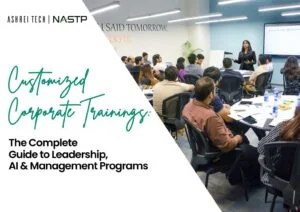
Every customized program starts with a needs discussion, as described in our complete guide to customized corporate training in Karachi. If you prefer open workshops, see the corporate training calendar.
Final Thoughts
Generative AI rewards organizations that build skills deliberately. Start by understanding your current gaps, teach the essentials of literacy, prompting, verification, privacy and ethics, and give leaders the strategy and governance knowledge they need. Begin with a small pilot, learn quickly and expand.
Ready to build an AI training program around your team? Request a customized training plan from AshreiTech Academy, or start with our free Training Needs Analysis template to map your first AI skill gaps.