Every organization says it wants stronger leaders. Far fewer can say what their leadership program is meant to change. Many end up with a few days of inspiring talks, good feedback scores and no visible difference in how managers run their teams.
A leadership development program works when it is designed backwards from a business result. This guide walks through how to do that: who to include, what to teach, how to structure the learning and how to know whether it worked. Use it to build a program yourself or to brief a training partner.
What Is a Leadership Development Program?
A leadership development program is a structured, ongoing learning process that builds the skills, habits and judgment managers need to lead people and deliver results. It usually combines workshops, practical assignments, coaching and feedback over weeks or months, rather than a single event.
The key difference from a one-off workshop is application. Participants practise new behaviours on the job, get feedback and refine them. That is what turns knowledge into habit.
Why Many Leadership Programs Fall Short
Before designing yours, it helps to know where programs typically go wrong:
- No clear goal. The program exists because “we should invest in leadership,” not because of a specific problem to solve.
- Content that is too generic. Participants sit through theory that doesn’t connect to their daily challenges.
- Learning without practice. People leave motivated, return to a full inbox and revert to old habits within weeks.
- No manager support. The participant’s own boss is not involved, so new behaviours aren’t reinforced.
- No measurement. Success is judged by whether people enjoyed the sessions, not whether anything changed.
Each step below is designed to avoid these traps.
How to Design a Leadership Development Program: 6 Steps
Step 1: Start with the business goal
Ask what you want to be different in 6 to 12 months. Good goals are specific and observable, for example:
- Reduce the number of managers who leave within their first year in the role
- Improve employee engagement scores in a particular department
- Prepare a pipeline of internal candidates for senior roles
- Help managers lead a team through a restructuring or growth phase
If you can’t state the goal in a sentence, the program isn’t ready to be designed.
Step 2: Decide who the program is for
Leadership needs differ by level, so one program rarely fits everyone. Most organizations work with three broad groups:
- Emerging leaders and first-time managers. Focus on self-awareness, communication, delegation and taking ownership.
- Mid-level managers. Focus on managing performance, leading other managers, influence and cross-team collaboration.
- Senior leaders. Focus on strategy, vision, decision-making and leading change.
Keep cohorts small enough for real discussion, and group participants at a similar level so that conversations stay relevant. If your target group is newly promoted managers, see our guide to management training for first-time managers.
Step 3: Identify the real skill gaps
Don’t assume you know what managers need. Check. Useful sources include:
- Short surveys of managers and their teams
- Interviews with senior leaders
- Performance review themes
- Engagement and exit-interview feedback
- A leadership style or 360-degree assessment
This step keeps the program tied to real problems and prevents wasted time on topics your managers already handle well. Our guide to training needs analysis explains how to do this in practice.
Step 4: Choose your core modules
Based on the gaps, select a focused set of modules. Six to eight is usually enough. A typical structure looks like this:
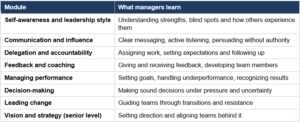
Choose the modules that fit your goal rather than covering everything. If your organization is going through major change, for instance, give more weight to the change module. Our article on leadership training for mid and senior managers leading through change covers this in more depth.
Step 5: Mix the learning formats
Leaders learn best by doing, discussing and reflecting, not by listening alone. A well-rounded program blends several formats:
- Interactive workshops for new concepts, case studies and role-play
- On-the-job assignments where participants apply a skill to a real project
- Coaching or peer groups for reflection and accountability
- Feedback tools such as assessments or manager check-ins
- Short follow-up sessions to review progress and refresh key ideas
A commonly used guideline suggests that most development happens through experience on the job, with the rest coming from relationships and formal learning. You don’t need to follow any exact ratio, but the principle holds: workshops alone are not enough.
Step 6: Build in application and measurement
Plan the follow-through from day one. Give each participant an action plan with two or three behaviours to practise, ask their managers to support them and schedule check-ins. Then decide in advance how you will measure results (see below).
Sample 3-Days Program Roadmap
Here is an example structure for a group of mid-level managers. It is a starting point to adapt, not a fixed formula.
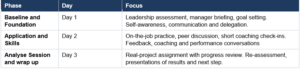
Notice the alternating rhythm of learning and practice. That gap between sessions is where behaviour change happens.
How to Measure Whether the Program Worked
Many organizations use the four levels of evaluation developed by Donald Kirkpatrick, which move from simple to meaningful:
- Reaction: Did participants find the program useful and relevant?
- Learning: Did they gain the intended knowledge and skills?
- Behaviours: Are they doing things differently at work? Ask their teams and managers.
- Results: Did the business goal from Step 1 move? Think engagement, retention or team performance.
Most organizations stop at level 1. The real value sits in levels 3 and 4, so plan to check in on these three to six months after the program ends.
Common Mistakes to Avoid
- Treating it as a one-time event instead of a journey
- Including managers who aren’t ready or willing to participate
- Skipping the participants’ own managers, who need to reinforce the learning
- Overloading the agenda with too many topics
- Ignoring company culture, so that new habits clash with how things actually work
How AshreiTech Can Help
At AshreiTech Academy, we design leadership programs around your organization rather than handing you a standard course. Our existing programs, including the Leadership & Management Development Program, The Leadership Shift, NextGen Leadership Accelerator and Mastering Vision-Driven Leadership, serve as building blocks. We tailor the content, case studies, duration and delivery to your goals, and deliver at your workplace or at our Karachi training centre.
Read more about how this works in our complete guide to customized corporate training in Pakistan.
Ready to Build a Leadership Program for Your Managers?
Tell us your goals, your audience and your timeline, and we will design a leadership development program around them.
Request a customized training plan or contact us at msalman@ashreitech.com or +92 307 087 0874