Training budgets are often spent on the topics that sound useful rather than the ones the business actually needs. A team gets a communication workshop when the real problem is unclear goals. A manager attends a leadership course when the gap is in coaching skills. The result is training that people enjoy but that changes little.
A training needs analysis (TNA) prevents this. It is the step that tells you who needs training, on what, and why, before you spend a rupee. It is also the first stage of any customized program, as explained in our complete guide to customized corporate training in Pakistan. This guide explains what a TNA is, walks you through five practical steps, gives you a template to use, and shows how to measure training ROI afterwards.
What Is a Training Needs Analysis?
A training needs analysis is a structured process for identifying the gap between the skills your people have today and the skills they need to meet business goals. The output is a clear list of training priorities, matched to specific roles, teams and outcomes.
A TNA answers three questions:
- What does the business need to achieve? (goals and performance targets)
- What are people currently able to do? (current skills and behaviours)
- What is the gap, and can training close it? (the actual training need)
That last question matters. Not every performance problem is a training problem. If employees miss targets because of broken processes, poor tools or unclear expectations, training alone won’t fix it. A good TNA separates the problems training can solve from the ones it can’t.
Why a Training Needs Analysis Is Worth Doing
- It saves money. You invest only in training that addresses a real gap.
- It improves relevance. Content is built around actual challenges, so participants see why it matters.
- It wins leadership support. A clear link between training and business goals makes budget approval easier.
- It makes results measurable. You define the starting point, so you can see what changed.
- It makes customization possible. A TNA gives a training provider the detail needed to design a program for your team, as explained in our guide to customized corporate training in Pakistan.
How to Conduct a Training Needs Analysis: 5 Steps
Step 1: Define the business goals
Start with outcomes, not courses. Ask what the organization, department or team needs to achieve in the next 6 to 12 months. Examples include improving customer satisfaction, launching a new product, reducing errors or preparing for expansion.
Write each goal in measurable terms so you can later judge whether training helped.
Step 2: Identify the skills and behaviours required
For each goal, list the skills and behaviours people need in order to achieve it. If the goal is to reduce customer complaints, the required skills might include active listening, handling difficult conversations and product knowledge.
Use job descriptions, competency frameworks and input from team leaders to build this list.
Step 3: Assess current performance and skills
Now measure where people are today. Combine several sources so that no single opinion skews the picture:
- Surveys and self-assessments for a broad view across many employees
- Interviews and focus groups for depth on specific issues
- Manager input on observed strengths and gaps
- Performance data, such as reviews, sales figures, quality metrics or error rates
- Customer or stakeholder feedback
- Skills tests or observation for technical or hands-on skills
Step 4: Analyze the gaps and prioritize
Compare required skills against current skills. Then rank the gaps by two factors: how much they affect business goals, and how many people they affect. A gap that hurts a key goal and spans a whole team comes before one that affects a single person’s minor task.
For each gap, decide whether training is the right response. If the cause is a process, tool or motivation issue, address that first.
Step 5: Recommend and plan the training
Turn priorities into a plan. For each training need, specify:
- The target group
- The learning objectives
- The format (workshop, coaching, on-the-job practice, e-learning)
- The timeline and budget
- How success will be measured
This plan becomes the brief you can give to your internal team or an external provider.
Matching Skill Gaps to the Right Training
Once your gaps are ranked, match each one to a program that fits. These guides from our content series show what that looks like in practice:
- Managers who need stronger leadership skills: see our guide to designing a leadership development program for managers.
- Senior leaders guiding teams through restructuring or growth: read about leadership training for mid and senior managers leading through change.
- Newly promoted or frontline managers: start with management training for first-time managers.
- Teams that need to use AI confidently: explore generative AI training for employees and business leaders.
- HR teams adapting to AI: see AI skills for HR business partners.
If your gaps cut across several of these areas, a customized corporate training program can combine them into one plan.
Free Training Needs Analysis Template
Spot skill gaps, rank them by priority and link every training action to a business goal. One row per gap, ready in Excel.
Sample Questions for Your TNA Survey
Keep surveys short, ideally under 15 questions. Useful questions include:
For employees
- Which tasks in your role do you find most difficult or time-consuming?
- Rate your confidence (1 to 5) in each of these skills: [list key skills].
- What training would help you do your job better?
- What stops you from performing at your best?
For managers
- Which skills does your team most need to improve to meet this year’s goals?
- Where do you see repeated mistakes or delays?
- Which team members are ready for bigger responsibilities, and what do they need?
For leaders
- What are the three biggest priorities for the business this year?
- Which capabilities do we lack to achieve them?
How to Measure Training ROI
Once training is delivered, you need to show whether it was worth it. Here is a practical approach.
1. Set the baseline before training
Record the starting figure for the metric you want to change: error rate, sales per employee, customer satisfaction, time to complete a task, staff turnover or engagement score.
2. Choose metrics linked to your goal
Match the metric to the training. Examples:
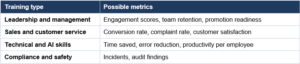
For examples of how to measure results for specific programs, see the evaluation section of our leadership development program guide and our guide to generative AI training for employees.
3. Evaluate at several levels
The Kirkpatrick model is widely used and looks at four levels: reaction (did they find it useful), learning (what did they gain), behaviour (what changed at work) and results (did the business metric move). Many organizations also add a fifth level, ROI, popularized by Jack Phillips.
4. Calculate the ROI
The standard formula is:
ROI (%) = (Net program benefits ÷ Program costs) × 100
Where net program benefits = monetary benefits − program costs.
Illustrative example (numbers are for demonstration only): Suppose a customer service program costs PKR 500,000 in total, including fees, materials and staff time. Six months later, you estimate the benefits, such as fewer refunds and repeat calls, at PKR 800,000. Net benefits are PKR 300,000, so ROI = (300,000 ÷ 500,000) × 100 = 60%.
5. Be honest about attribution
Many factors affect results at the same time. Where possible, compare trained and untrained groups, ask managers to estimate how much of the change came from the training, and report conservative figures. Credible, modest results are more convincing than inflated ones.
Not every benefit has a price tag. Improved morale, stronger leadership and better teamwork matter even when they are hard to convert into money. Report these alongside your ROI figure.
Common TNA Mistakes to Avoid
- Skipping straight to solutions. Choosing a course before understanding the problem.
- Relying on a single source. Surveys alone, or manager opinion alone, give a partial view.
- Asking only what people want. Employees may request popular topics rather than what the business needs.
- Ignoring non-training causes. Unclear roles, tools or incentives can’t be fixed with a workshop.
- Not planning measurement. If you don’t set a baseline, you can’t prove results later.
How AshreiTech Can Help
At AshreiTech Academy, our customization process starts with understanding your needs. We discuss your goals, identify the real skill gaps and then design a program, with the right trainer, content and format, to close them. You can use the template above on your own, or share your findings with us and we will turn them into a tailored plan in Leadership, AI, Digital Skills, Finance or Management.
Ready to Turn Your Training Needs into a Plan?
Share your goals and skill gaps with us, and we will design a customized training program around them.